

All Seasons Chimney, Inc.: The Hudson Valley’s Expert Chimney Masons
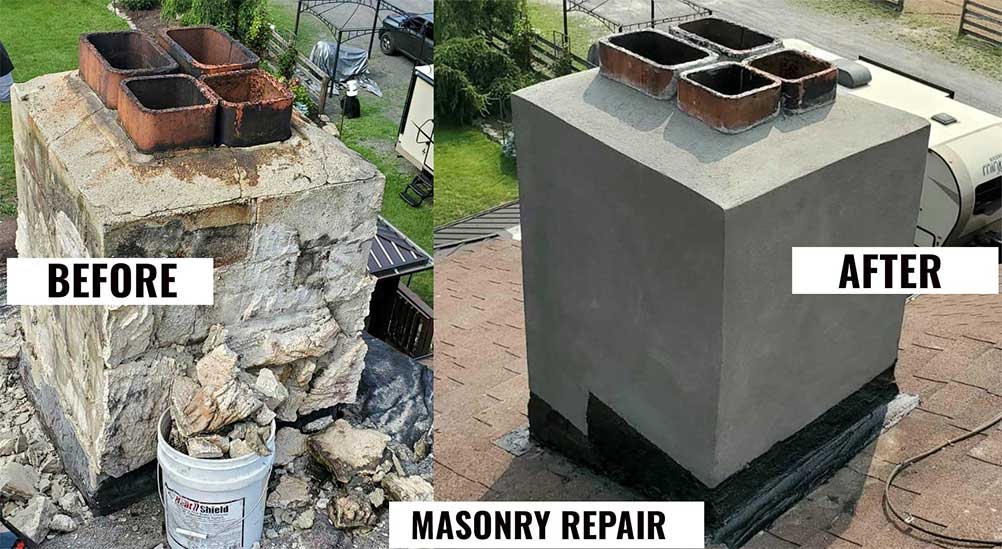
Many of today’s chimneys are prefabricated or “manufactured” (i.e., made of metal) which makes them a more cost-effective option for those who wish to install a wood stove or fireplace in their home. However, we find that a good deal of our customers still prefer the traditional look and durability of a masonry chimney, which dates back to at least the early 17th century. Still others have a prefabricated chimney but wish to surround it with brick and mortar to give it a sturdier and more traditional appearance. Whether you have a traditional masonry chimney or a brick and mortar surround, weather, time, and moisture damage and contribute to masonry decay. For chimney masonry repairs near you, reach out. The experts at All Seasons Chimney, Inc. can give your masonry chimney the TLC it needs at a fair price.

What Are Common Chimney Masonry Problems?
No thanks to Mother Nature and Father Time, your chimney’s masonry is bound to take a beating over time. Here are some problems we often identify with our customers’ brick and mortar chimneys:
- Stained masonry—mildew or efflorescence (a crystalline deposit)
- Moss growth on masonry
- Crumbling masonry
- Spalling bricks (brick faces popping off)
- Missing bricks
- A leaning chimney
Many of these problems are indicative of other, unseen chimney problems, which can be identified during a professional chimney inspection (we recommend one annually). To prevent these problems from reoccurring, you’ll also want to address the cause. A certified chimney technician can recommend a plan of action that will keep your chimney in good condition year round.

What Causes Chimney Masonry to Deteriorate in the First Place?
Chimney masonry doesn’t fail overnight – it deteriorates gradually through a combination of environmental exposure, material fatigue, and deferred maintenance. Understanding the root causes helps homeowners take a proactive approach rather than waiting until a small repair becomes a major rebuild. The most common causes of masonry deterioration include:
- Water and moisture infiltration. Water is the single greatest enemy of masonry chimneys. Rain, snow, and ice work their way into even the smallest cracks and gaps in mortar joints, brick faces, the crown, and flashing seals. Once inside, water causes rust, erosion, efflorescence (white staining), and progressive structural weakening.
- Freeze-thaw cycling. This is the dominant force driving chimney deterioration in the Hudson Valley specifically. When water trapped inside masonry freezes, it expands, physically forcing mortar and brick apart. In a Hudson Valley winter, this cycle can repeat hundreds of times between November and March. Over years, the cumulative damage is dramatic: mortar joints erode, bricks crack and spall, and crowns develop major fractures.
- Thermal expansion and contraction. Every time you light a fire, your chimney’s materials heat up and expand. Every time the fire goes out, they cool and contract. This repeated thermal stress weakens mortar joints and can crack flue tiles and firebox components over time.
- Age and material fatigue. Many homes throughout Orange, Dutchess, Ulster, Rockland, and Westchester counties have chimneys that are 50, 75, or even 100+ years old. Even the best-quality original masonry has a finite lifespan, and materials installed decades ago may no longer meet modern safety and performance standards.
- Poor original construction. Chimneys built without proper crown design, inadequate flashing, or substandard mortar mixes are far more vulnerable to accelerated deterioration, and many older Hudson Valley homes fall into this category.
- Lack of regular maintenance. Skipping annual inspections and cleanings allows small problems – a hairline crack in the crown, a slightly eroded mortar joint, a loosened cap, etc. – to grow into major structural issues before they’re ever identified.
What Is Tuckpointing & When Is It Necessary?
Tuckpointing (also called repointing) is one of the most common and most important chimney masonry repair procedures. It involves carefully removing deteriorated, crumbling, or missing mortar from between the bricks or stones of your chimney – typically to a depth of about ¾ to 1 inch – and replacing it with fresh, properly mixed mortar that bonds tightly to the surrounding masonry.
Why does mortar fail? Mortar is softer than brick by design – it’s intended to act as a sacrificial material that absorbs structural stress and accommodates minor movement. This means mortar erodes faster than the bricks themselves. Most mortar has an effective lifespan of 20 to 30 years under normal conditions… In harsh climates, like the Hudson Valley’s, it can begin deteriorating significantly earlier.
Signs you need tuckpointing:
- Mortar that appears recessed, crumbling, or absent between bricks
- Loose bricks or minor shifting in the chimney structure
- Visible white staining (efflorescence) on the chimney exterior
- Water leaking into the firebox or home near the chimney
- Mortar debris or small brick fragments in the firebox
All Seasons Chimney performs professional tuckpointing for homeowners throughout the Hudson Valley, using mortar formulations appropriate for chimneys – not the standard construction mixes that are sometimes incorrectly used for chimney repairs.
How Do I Know if My Chimney Needs Masonry Repair Versus a Full Rebuild?
This is one of the most important questions a homeowner can ask – and the honest answer is that it depends on the extent, location, and type of damage present. At All Seasons Chimney, we always recommend the most conservative approach that adequately addresses the safety and structural concerns identified, which often means repair over rebuilding. However, there are situations where a partial or full rebuild is the right call.
Masonry repair is typically appropriate when:
- Mortar joints are eroded but individual bricks are structurally sound
- The crown has cracked but the overall chimney structure remains intact
- A limited number of bricks are spalled or damaged and can be individually replaced
- The firebox has damaged refractory mortar or limited brick deterioration
- The smoke chamber needs parging but the overall structure is solid
- Damage is concentrated in a specific section that can be isolated and addressed
Partial or full rebuild is typically necessary when:
- Large sections of the chimney above the roofline have experienced widespread brick or mortar failure that makes repair impractical
- The chimney has shifted, leaned, or separated from the house due to foundation movement or severe structural compromise
- Bricks are so extensively spalled, cracked, or disintegrating throughout a section that individual replacement would be more costly and less effective than rebuilding
- The original construction was so poor that repairs would simply fail again in short order
- Water infiltration has been occurring for years without correction, resulting in cascading damage through multiple components simultaneously
A thorough inspection, including a video scan of the flue, is essential to accurately assess the full scope of damage before recommending repair versus rebuild. At All Seasons Chimney, we document our findings with photos and video and walk you through exactly what we observed and why we’re recommending the approach we are. We never recommend a rebuild when repair is genuinely sufficient, and we never recommend an inadequate repair when a rebuild is what the structure truly needs.
What Is Spalling Brick? How Serious Is It?
Spalling refers to the flaking, chipping, crumbling, or breaking away of the outer face of a brick — the characteristic pitting and surface deterioration that gives older chimneys a weathered, damaged appearance. While it might initially look like a purely cosmetic issue, spalling brick is actually a serious structural and safety concern that demands professional attention.
The primary cause of spalling is moisture infiltration combined with freeze-thaw cycling – the defining combination in Hudson Valley winters. When water enters the porous surface of a brick and then freezes, the expanding ice exerts enormous internal pressure that literally blows the face of the brick apart.
Individual spalled bricks can be replaced when damage is limited. When spalling is widespread throughout a section of the chimney, partial or full rebuilding of that section may be necessary. Following repair, professional waterproofing treatment is strongly recommended to prevent the moisture infiltration that drives future spalling.
Will Chimney Waterproofing Protect My Brickwork & Masonry?
Following any masonry repairs or tuckpointing work, we always recommend that you retain the good condition of your chimney by having it professionally waterproofed or sealed. The water-soluble, earth-friendly application that we use effectively keeps water out of your brick and mortar while still allowing your masonry to breathe (meaning toxic gases can be released from the masonry instead of trapped inside).
Call or Book Online Today
To schedule an appointment with All Seasons Chimney, simply call 845-567-0044 or click here.
In addition to chimney work, the pros at All Seasons Chimney handle dryer vent cleaning and repairs.
Stainless steel chimney liners can restore your chimney to safe operation. Call us for professional chimney repair services like this one and more.