For Chimney Flashing Repair & Installation Services Near Poughkeepsie, Trust Us
Ever wondered about the band of stainless steel or copper that lies at the place where your chimney and your roof intersect? That’s called “flashing,” and it is an integral component of any healthy chimney because it keeps this vulnerable seam weatherproof. Flashing usually appears to stair-step up the base of your chimney, because it is cut, bent, and woven together to maintain water tightness. As such, this is known as “step flashing.”
How Is Chimney Flashing Installed?
The dimension of every chimney is different. Likewise, the pitch of each of our customers’ roofs is different, as are the roofing materials, the age and the condition of the roofs. This is why flashing installation is a custom project that’s done on site. Needless to say, it’s best left to a professional.
When installing flashing around our clients’ chimneys, we not only rely on our decades of experience, but we also try to think like water. We know that rain doesn’t just fall straight down from the sky but can also be blown sideways onto your roof and chimney. Over time, we’ve learned all the paths that water tends to travel to enter your chimney and we’ve learned how to close off these common entrances.
Why Is My Chimney Flashing Leaking?
When All Seasons Chimney, Inc. gets a call about a leaking chimney, our first thought is usually of the flashing. Flashing too often fails for one of the following reasons:
- It was poorly installed in the beginning
- Improper materials were used
- It is old and worn out
- Your house has settled and shifted
- Part of your flashing is missing due to weather or animal tampering
- Your flashing is rusted through
- Your flashing is covered in roofing tar
- You need a new roof or some new shingles
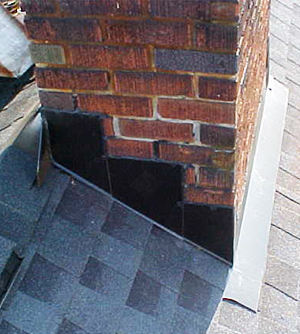
In some cases, we are able to effectively patch or repair your existing flashing. In other cases, we determine that it’s better to rip up the flashing and customize new flashing so that you won’t have to worry about your flashing leaking again.
Damaged flashing is sometimes indicative of a larger problem – for example: your roof may need to be replaced entirely. If we judge this to be the case, we are happy to recommend a local roofer who does great work at a fair price. We find that flashing tends to unite chimney technicians and roofers, as we often get calls about flashing installation to complement the installation of a new roof, and often call a roofer before we install flashing. Both jobs are best left to their respective experts.
What Are the Signs of Damaged or Failing Flashing?
Because flashing sits at the roofline, damage often goes unnoticed until water starts appearing inside the home. Faulty flashing is actually one of the most common causes of chimney leaks, and it’s frequently misdiagnosed as a roofing problem when it’s really a flashing issue. Watch for these warning signs:
- Water stains on the ceiling or walls around the chimney, especially after heavy rain
- Rust stains streaking down the chimney or on the flashing metal itself
- Visibly lifted, bent, loose, or missing flashing pieces
- Cracked, dried-out, or peeling sealant (tar or caulk) around the flashing edges
- Dripping or dampness in the attic near the chimney penetration
- Gaps where the flashing meets the brick or the roof shingles
Can Flashing Be Repaired, or Does It Need to Be Replaced?
It depends on the condition of the existing flashing, and a professional inspection is the best way to determine the right approach.
- Repair may be appropriate when the flashing is fundamentally sound but has a localized problem—such as failed sealant, a few loose sections, or minor separation. Re-securing the metal and applying fresh, professional-grade sealant can restore the watertight seal.
- Replacement is the better long-term solution when flashing is heavily rusted, improperly installed, widely damaged, or nearing the end of its lifespan. In these cases, patching only delays an inevitable leak. A full replacement – properly layered and embedded into the masonry – provides a lasting, reliable seal.
We always recommend fixing the root cause rather than applying a quick patch. A properly installed flashing system can last for decades, while repeated temporary fixes tend to cost more over time and leave your home vulnerable in the meantime.
When Should I Have My Chimney Flashing Inspected?
We recommend having your flashing checked at least once a year, ideally as part of your annual chimney inspection. You should also schedule an inspection if you:
- Notice any signs of water intrusion near the chimney
- Have recently experienced a major storm, high winds, or heavy ice
- Are having roof work done (an ideal time to address flashing)
- Rely on flashing that was previously “repaired” with tar or caulk
- Can’t remember the last time it was professionally evaluated
Catching flashing problems early is one of the simplest and most cost-effective ways to prevent water damage. A small flashing repair today can save you from ceiling stains, mold, rotted framing, and expensive interior repairs down the road.
Schedule Your Chimney Flashing Repair Now
Schedule an appointment with one of our CSIA-certified technicians today by calling 845-552-0541 or clicking here.
Waterproofing may be what’s needed to stop your leaking chimney and should be done by professionals like All Seasons Chimney.